RESEARCH
Galactic Archaeology is a field dedicated to reconstructing the formation and evolution of the Milky Way by examining the current properties of its stars. Stars preserve in their atmospheres the chemical signatures
of the gas clouds from which they formed. As different generations of stars end their lives, they enrich the interstellar medium with new chemical elements, creating a record of Galactic history. By analyzing these
chemical properties alongside kinematic data, it is possible to distinguish between distinct stellar populations and trace the processes that shaped them. Because we can observe it with a high level of detail from
the inside out, the Milky Way serves as a primary laboratory for studying disk galaxies. My research focuses mostly on the Galactic disk. Using chemical and kinematic analyses, I investigate the mechanisms involved
in the formation and evolution of the Milky Way’s structures, with a particular emphasis on the thin and thick disk configuration.
Recent results from our work, along with emerging observational evidence, suggest that the Milky Way may have undergone a clumpy disk phase during its early stages. High-redshift observations with the Hubble Space Telescope
and, more recently, the James Webb Space Telescope have revealed that massive, star-forming clumps are ubiquitous in high-redshift disk galaxies, including potential Milky Way progenitors. Establishing whether our Galaxy was
once a clumpy galaxy is critical for understanding the origin of its present-day stellar populations and structural components. Furthermore, from an extragalactic perspective, identifying stars formed within ancient clumps
in our local neighborhood provides unique insights into the internal physics of these structures, which cannot be resolved at high redshift. Consequently, my current efforts aim to find decisive observational signatures that
either support or constrain a clumpy early phase for the Milky Way.
Old thin disk stars
Borbolato et al. (2025)
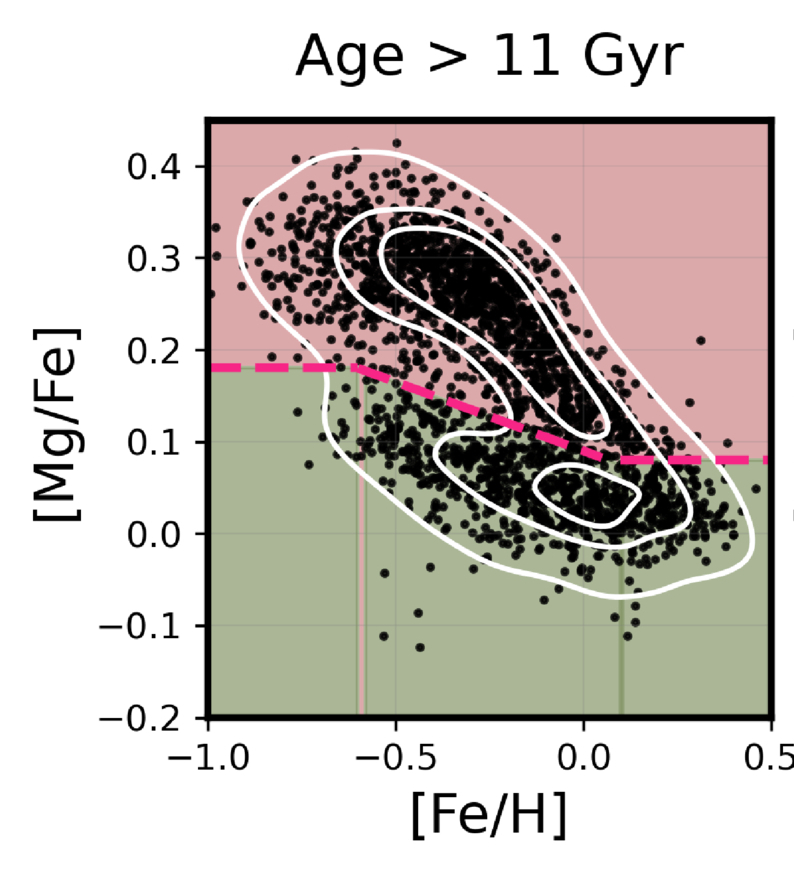
The traditional view of Milky Way disk formation holds that the thick (enriched in [α/Fe]) and thin (low-[α/Fe]) disk populations formed sequentially, with the thin disk being younger.
This chemical bimodality is commonly attributed to a major merger during the early stages of the Milky Way. However, in Borbolato et al. (2025), we
show that a significant population of thin-disk stars (both chemically and kinematically defined) predates this merger and cannot be explained
by this traditional model. This result prompts the search for alternative models for the formation of the Milky Way disk's chemical bimodality that allow
for the co-formation of these two populations from early times, such as the clumpy disk model.
If you are interested in learning more details about this research, I invite you to click the link below to access the paper.